Three-Level Data Organization
Organize source images, defects, reviews and reports by wind farm, turbine and blade.
 Contact Us ↗
Organizes inspection data by wind farm, turbine and blade, connecting blade-image organization and stitching, AI suspect screening, expert review, historical comparison and multi-level reporting.
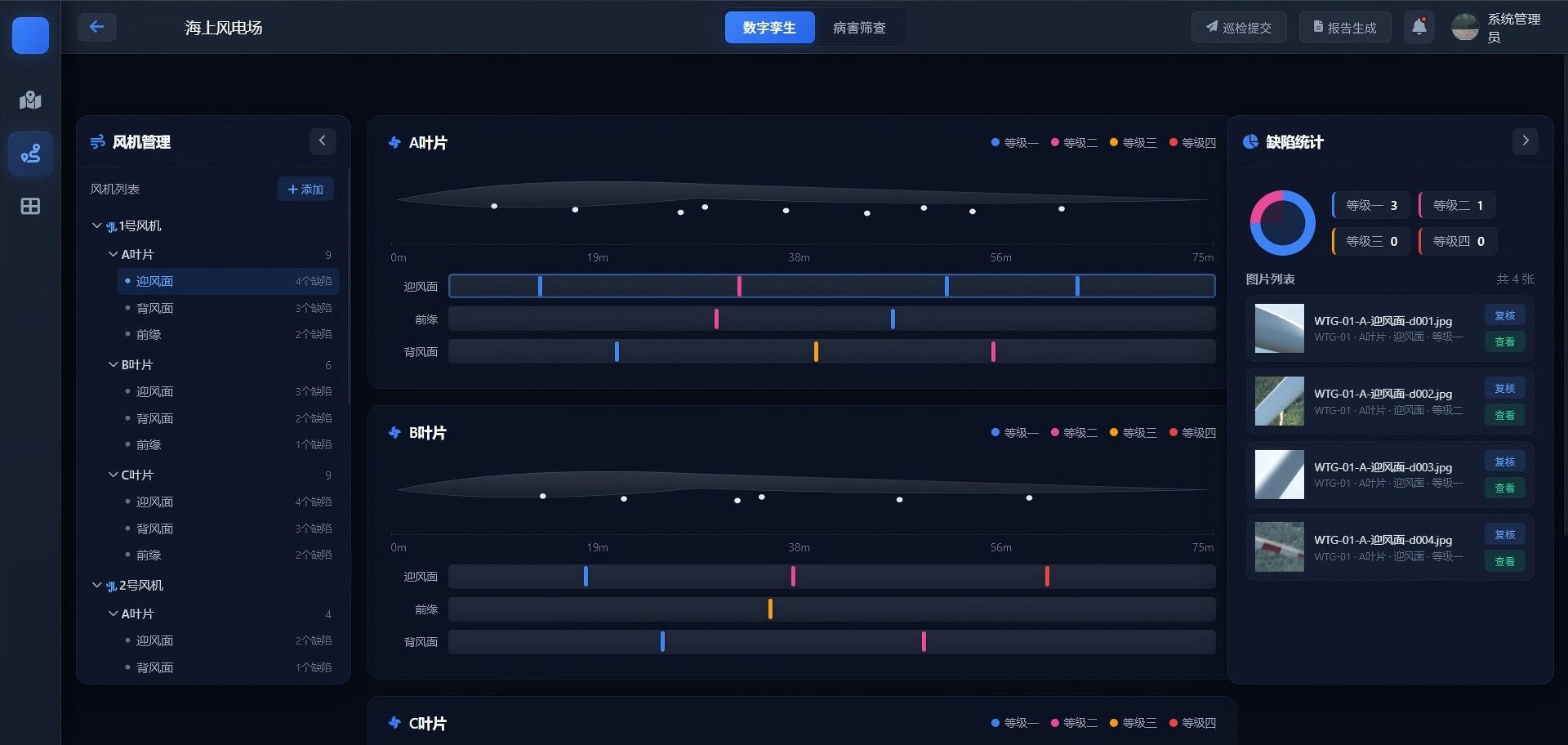
The platform associates field images with wind farm, turbine, blade and surface orientation. AI output is treated as suspected defects for professionals to confirm, exclude, grade and annotate.
Raw images, detection records, human reviews and reports can be retained by project, supporting retrieval, periodic comparison and maintenance planning.
Organize source images, defects, reviews and reports by wind farm, turbine and blade.
Organize and stitch local images of one blade into a continuous blade-level view.
AI outputs suspected defects for professional confirmation, exclusion, grading and annotation.
Retain historical results by project for periodic comparison and multi-level reports.
Data completeness, acquisition angle and clarity directly affect stitching and AI results. Platform output requires professional review before maintenance use.
Import inspection images, routes and turbine data and verify files and metadata.
Organize images by turbine, blade and surface direction into continuous blade views.
Use deployed models to output suspected position, type and confidence.
Confirm or exclude suspects and annotate severity, position and size.
Link current results to historical inspections for professional change comparison.
Summarize reviewed results and generate blade-, turbine- or farm-level reports.
A layered architecture stores source data, algorithm output and human conclusions separately for traceability.
A three-level hierarchy gives every image, suspect, review and report a clear owner, reducing reliance on folder names and memory.
The interface organizes results by Blade A/B/C and windward, leeward, leading-edge and other directions. Suspects trace back to images and enter review.
Using image features, capture pose and project parameters, the platform matches, optimizes and blends images into a continuous blade-surface view.
Stitch quality depends on overlap, angle, exposure, texture, motion blur and completeness. Source high-resolution images must remain available when stitched views are used for browsing and location.
The platform can deploy models for different defect types. AI results include suspected location, type and confidence and are not final conclusions.
Visible linear or network cracking requires source-image and professional confirmation.
Suspected peeling, flaking or exposed-substrate coating areas.
Visible corrosion, oxidation or pitting.
Suspected physical damage from dents, scratches, impact or lightning.
Filter review items by type, confidence, blade region and time.
Jointly view source, stitched and project-supported enhanced images.
Professionals issue conclusions; AI output is not treated as a final defect.
Record type, severity, position, size, contour and notes.
For blades with alignable historical data, the platform associates images and defects from the same region, shows changes in size, severity and new findings, and retains human verification.
Historical association depends on acquisition angle, calibration, image quality, blade pose and completeness and must not be treated as a structural-life conclusion.
Source Images, Position and Review Conclusion
Spatial Alignment and Human Verification
Size, Severity and New-Finding Comparison
Unwrapped view, defect list, distribution, details and history.
Three-blade summary, statistics, priority issues and history.
Completion status, turbine summary, type/severity distribution and priority list.
Reports can be viewed online and exported to PDF, Word and other project formats. Templates, statistics, maintenance recommendations and approval workflows require customer confirmation.
Batch-organize multi-turbine data under a unified review and reporting workflow.
Manage blade-defect records for high-salt-spray environments and limited maintenance windows.
Create traceable records including source images, location, review and reports.
Quickly summarize new suspects and priority turbines after typhoons, lightning or hail.
Associate pre- and post-maintenance inspections to help professionals verify treated areas.
Acquire multi-view blade images as required by the mission.
02 / EXECUTEConnect positioning, flight control and mission actions for aircraft execution.
03 / MONITORConfigure turbine missions, monitor dynamic inspection and retain manual intervention.
Organize imagery, AI suspects, human review, history and reports.
Provide wind-farm scale, acquisition method, sample data, defect standards and reporting requirements, and we will help confirm platform configuration and deployment.
Last updated