Intelligent Detection of Unusual Behaviour Onboard Trains
Detect incidents across the train between patrols
The CIDS carriage monitoring system analyses existing CCTV onboard to detect passenger and crowd incidents, check terminal clearance and flag unsafe driver actions. It retains the existing network, delivers end-to-end alerts within 5 s under test conditions and preserves evidence for review.
Cameras already provide pictures. What is missing is timely interpretation.
Blind spots
Crowding and limited space obscure a single viewpoint, particularly in corners.
Four cameras per car provide a 360° view; a six-car formation supplies 24 feeds.
Delayed response
A train patrol takes 2–5 minutes; incidents can develop before staff arrive.
End-to-end alert ≤5 s; crowd-event response ≤3 s.
Multiple handoffs
Crew report via a supervisor and the cab before information reaches the centre.
Structured alerts go directly to the cab and control centre and are synchronised to the cloud.
Staffing demands
Fatigue and attention affect the consistency of around-the-clock patrols.
Continuous monitoring and reviewed examples support model refinement. Crew remain responsible for intervention.
S3 / CIDS
System architecture
01
Capture
Four dome or fisheye cameras per car provide 360° coverage and 1080p RTSP feeds.
02
Edge
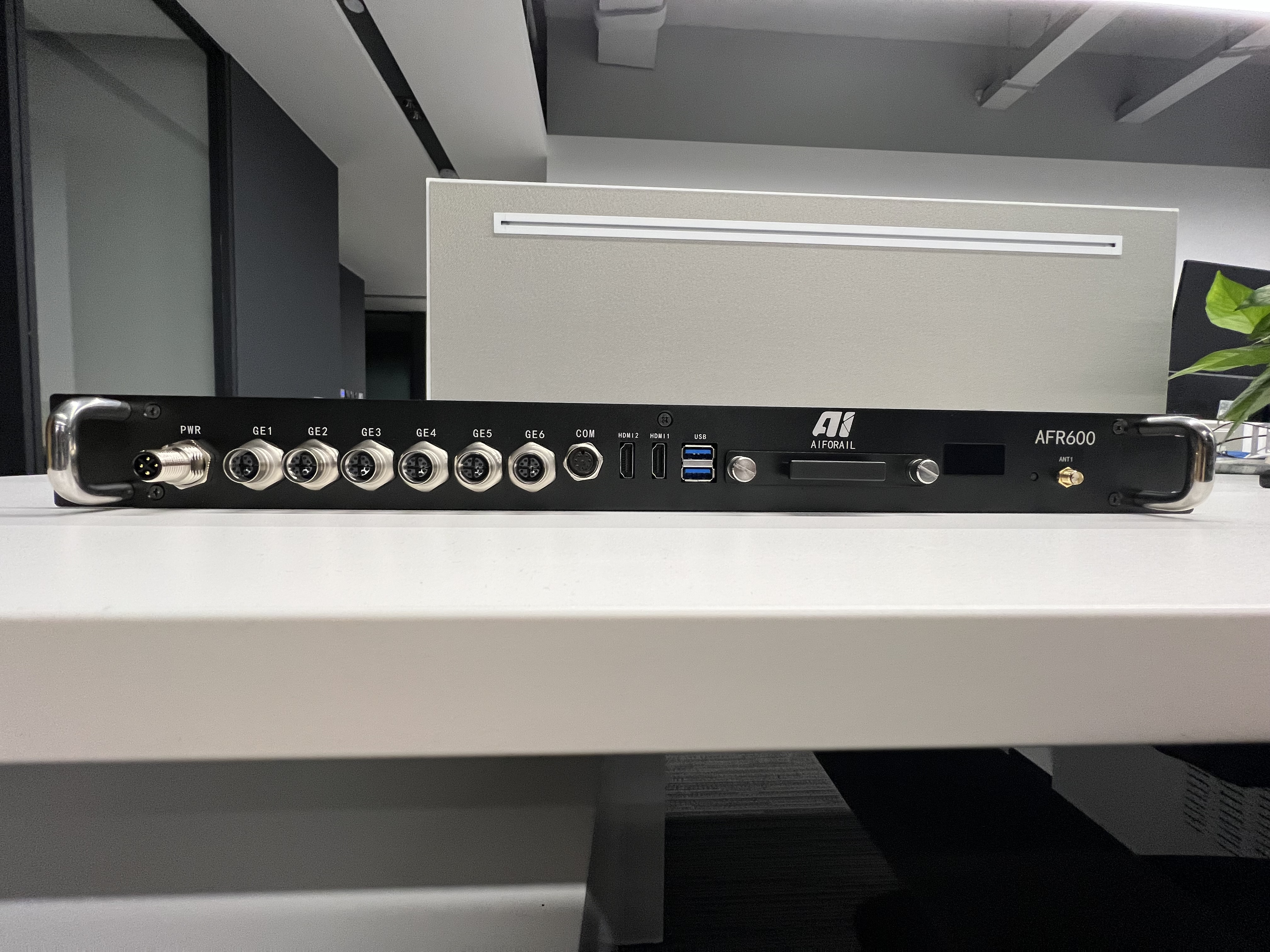
AFR600 performs onboard inference and buffers data in terabyte-class local storage during outages.
03
Platform
PIS switches and central servers handle timing, commands, device management, data cleansing and distribution by priority.
04
Interface
Cab pop-ups, live views, centre alerts and cloud records support tiered notification.
RTSP capture → PIS network → AFR600 inference → event record, marked image and preceding 30 s of video → central archive and alert display
S4 / CIDS
Onboard installation
Three deployment principles
Reuse existing feeds
Take RTSP video from the PIS switch without changing cameras or wiring.
Independent processing
Dedicated nodes operate without consuming the CCTV host’s computing capacity.
Remote control
The centre synchronises clocks and starts or stops detection remotely.
One node serves three or four cars. In this six-car example, cars 03 and 04 each carry an AFR600.
010203AFR60004AFR6000506
AFR600 onboard edge computer
Synchronised timestamps · Health checks every minute · Video ≥7 days, events ≥14 days, logs ≥30 days · Two-way PIS communication and resumable uploads
S5 / CIDS
Four detection tasks
F05
Passenger incidents
Detection targets
Falls, lying across seats and waving for help; concurrent targets supported.
Key metrics
≥2 Hz; response ≤5 s
Event output
Timestamp, car, door area, action and annotated image, plus video from 30 s before to 10 s after the event.
F06
Crowd incidents
Detection targets
Rapid dispersal, running or pushing by three or more people.
Key metrics
≥2 Hz; response ≤3 s
Event output
Each camera detects and reports independently, including within the same car.
F07
Terminal clearance
Detection targets
Remaining passengers of all ages; bags ≥15×15×5 cm and suitcases ≥30×40×10 cm.
Key metrics
≤3 s response; initiated by the centre after doors close.
Event output
Pop-up, still and preceding 30 s of video; each target reported separately.
F08
Driver incidents
Detection targets
Both hands off controls ≥5 s or head down ≥10 s.
Key metrics
≥2 Hz; response ≤3 s
Event output
A pop-up on the four-view cab terminal identifies type and position and captures evidence.
Figures refer to standard test conditions. Results depend on camera installation, light, crowding and software version; agreed project tests govern acceptance.
S6 / CIDS
From detection to response
01
Real-time detection
Onboard inference identifies movements and event features in the video.
02
Event confirmation
Classify the event, locate the carriage, establish the time and filter interference.
03
Evidence retention
Mark the image and save a 30-second recording around the incident.
04
Multi-channel reporting
Send encrypted reports over the dedicated PIS network to central and cloud services.
05
Terminal response
Display a cab alert, monitor at dispatch and retrieve the historical record.
Average response <2 s · event retention 100%
These are workflow test results, not per-function response limits. Recording windows are project-specific.
S7 / CIDS
Cab, operations centre and cloud displays
Cab terminal
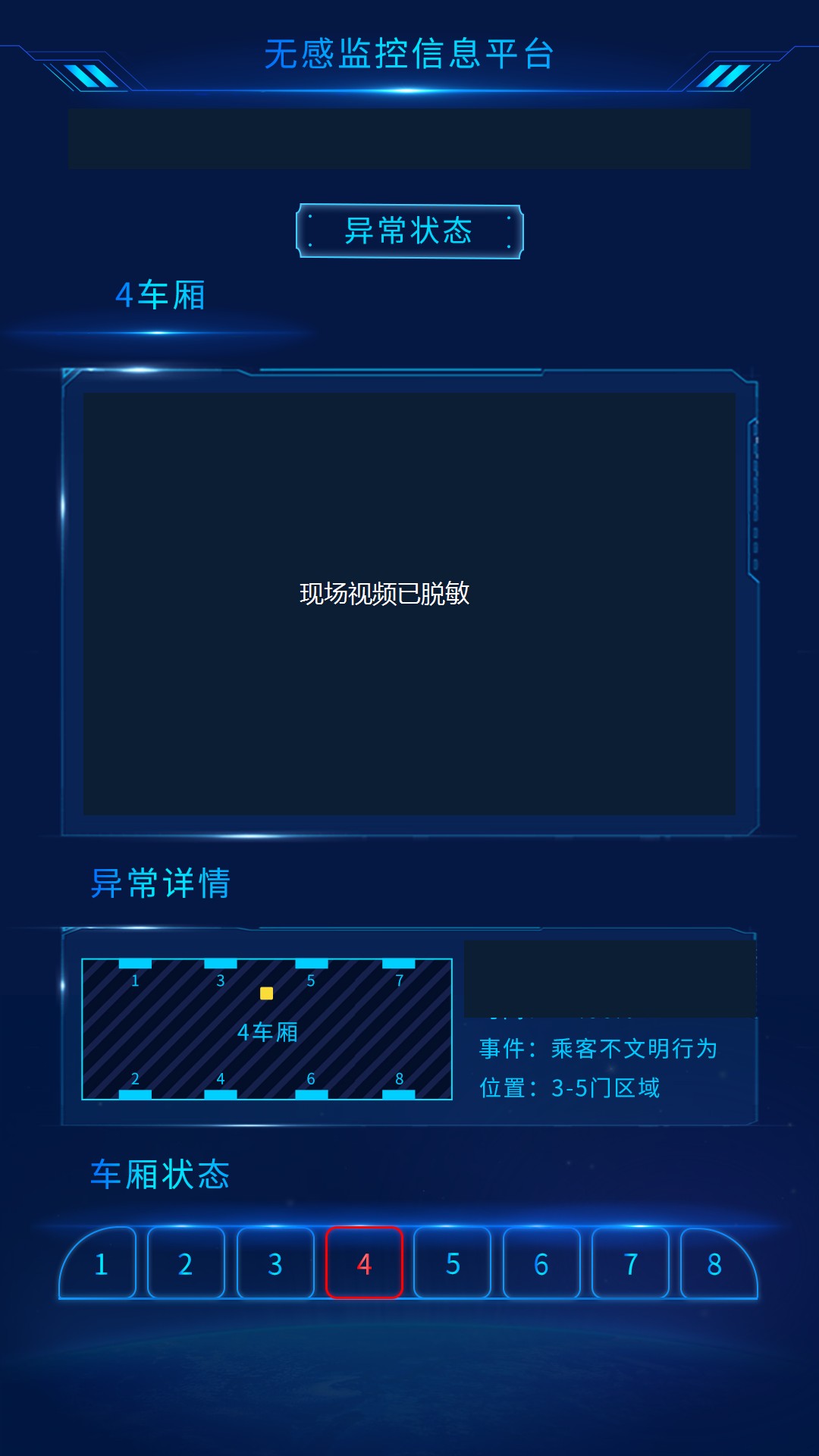
Cycles through four views and opens live video with event type and location on alarm.
Operations centre
Receives train health and events and issues clearance checks, clock updates and emergency dispatch instructions.
Cloud fleet platform
Monitor multiple trains, roll out remote updates, stream live video and review history.
Terminal alarm showing incident type, car location and status; footage and identifiers masked
S8 / CIDS
How onboard detection works
Multi-camera fusion in confined spaces
Complementary views reduce single-camera occlusion. Test detection accuracy exceeded 98%.
Temporal pose recognition
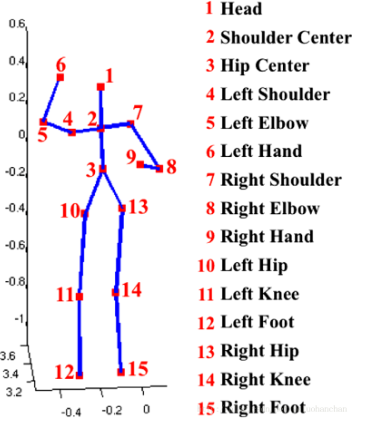
Track 15 body joints over time to distinguish walking, falls, reclining and waving for help.
Occlusion handling and cross-camera ReID
Match pedestrian features and tracks across views to associate observations of one person; camera-level reports remain independent.
32 TOPS onboard processing
Analyse onboard and transmit key events rather than all feeds. In testing, recognition exceeded 98% and processing latency was below 200 ms.
Illustration of body pose landmarks
Figures refer to standard test conditions. Results depend on camera installation, light, crowding and software version; agreed project tests govern acceptance.
S9 / CIDS
CIDS and crew patrols compared
Dimension
CIDS
Crew patrols
Detection and response
Continuous monitoring with alerts in seconds
Patrol cycle of 2–5 minutes
Peak-hour visibility
Continuous coverage from 24 feeds
Fixed views obstructed by crowds
Continuity
Designed for round-the-clock operation
Affected by fatigue and attention
Accumulated experience
Models refined with accumulated data
Staff turnover and repeated training
Incident response
Automatic alerts with event evidence
Staff can intervene and help on the spot
Service consistency
Consistent configured criteria
Varies with individual experience
CIDS monitors and records evidence. Crew assess the scene and can provide immediate assistance.
S10 / CIDS
Deployment requirements
In-service monitoring · Terminal clearance
Before installation
Installed cameras
1080p or higher with coverage of the main carriage area. Survey any gaps before adding cameras.
Onboard network
Confirm RTSP feeds are available at the PIS switch. A parallel connection retains existing wiring.
Formation
Six cars in the reference design, with one node per 3–4 cars. Confirm other formations separately.
Work window
Schedule installation and integration during overnight depot stays or maintenance windows outside service hours.
Centre integration
Confirm platform interfaces, protocols, alarm fields and integration responsibilities in advance.
Deployment on a six-car metro train covered installation, configuration, centre integration and acceptance. The line name and site footage are withheld at the customer's request.
TIDS protects the track ahead, EV-IPS supports engineering vehicles and CIDS monitors carriage interiors. Each may be deployed independently or planned at line level.
For an enquiry, specify line size, formation count, CCTV make and specifications, work windows and the current central platform.
Functions, specifications and cases shown on this site depend on product configuration, test conditions, site environment and project scope. Confirmed technical documents and acceptance results shall prevail. AI results are intended to assist operations and should be reviewed by qualified professionals where required.
Last updated
Intelligent Detection of Unusual Behaviour Onboard Trains | AIFORAIL Technology